
by Spenser Starke, Rowan Hall, and Matthew Mercer
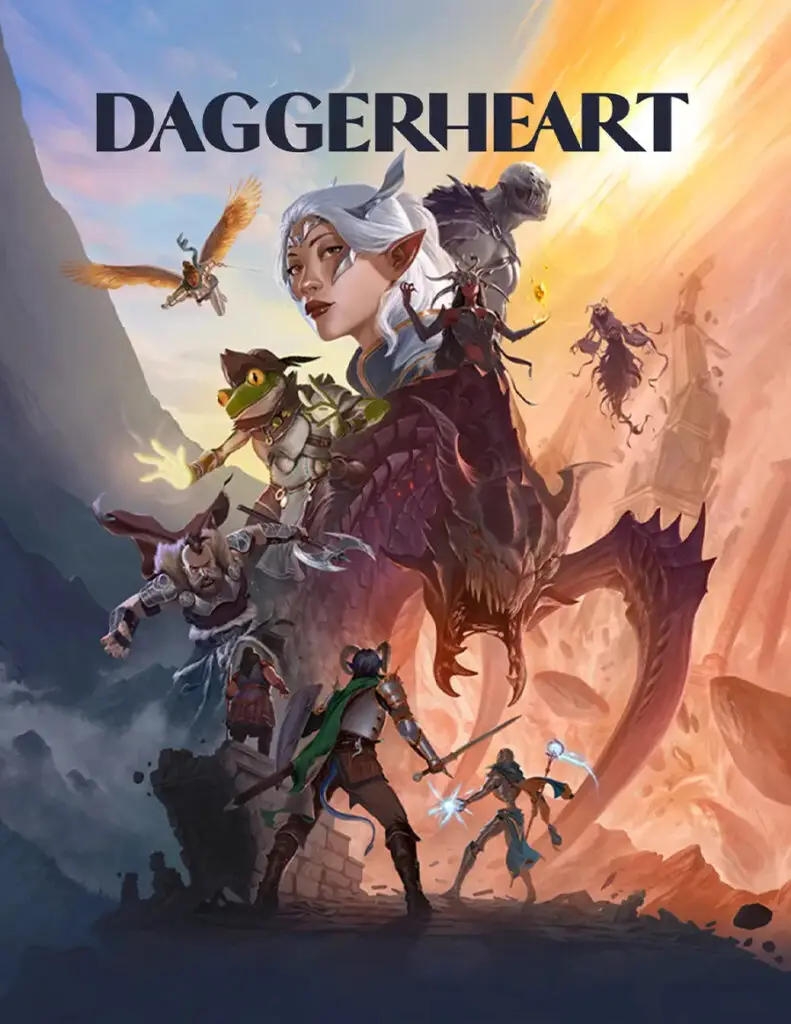
Much ado has been made about Daggerheart since its inception and it’s understandable how it has accrued so much hype. It’s connection to the highly-acclaimed Matt Mercer and his Critical Role TRPG orbit provides it with some serious bona fides in the gaming spaces. And as interest in the latest iteration of Dungeons and Dragons has not quite kept up to past editions, there is much debate in the community if Daggerheart will be the game to finally take the crown for the definitive fantasy tabletop roleplaying experience.
And now that the game has been released, all I can say is that the verdict is… maybe.
While this might seem like a bit of a cop-out, I will say that it’s too soon to tell if Daggerheart is going to be the new king-of-RPG-mountain. I cannot deny that it has some interesting mechanics in how it uses cards and tokens to track player resources in a way that is more engaging than just scribbling notes on a character sheet. I will say that character classes are more clearly defined in how their roles fit into the larger scope of the party. The Hope and Fear system offers an excellent means to allow the GM and players to have a tangible back-and-forth dynamic over the narrative. The domain system does an excellent job of making character options more understandable in their capabilities. And in spite of all of the “crunchy” mechanical arrangements of the system’s magic and combat, there are still enough open-ended means of tracking roleplaying beats with the rolls of the dice.
So, with all that high praise, what is the issue? I have a few nitpicks… For a start, the equipment options feel somewhat disappointing when compared to the vast variety of other options for character customization. It might seem like a bit of a nitpick, but having multiple tables dedicated to the weapon progression of “sword” to “slightly better sword” to “even more powerful sword” feels a tad artificial. The cards offered for “spellcasting” are an inspired gameplay choice, but the effects offered by the cards seem attuned almost solely for combat instead of offering the “utility” options found in other games. That appears to be the major issue that I would raise regarding Daggerheart, namely the fact that while it promises to be a storytelling engine, much of the focus is placed on combat. If that is what your gaming table is looking for, far be it for me to rain on your parade, but as both a player and as a GM I like to know that there are options to think outside the battlefield.
But again, the question remains… will Daggerheart will rise above Dungeons and Dragons to become the new gold standard? I don’t pretend to have a crystal ball on the subject and while there are other contenders to be found in Tales of the Valiant, Pathfinder, Dungeon Coach and other properties, I will freely admit that Daggerheart takes some novel approaches outside the more safe-and-familiar mechanisms of D&D. I don’t know if this game will fully eclipse D&D but I certainly think that it will give the old tabletop giant a run for its money. If you are looking for something that threads the needle between simulationist, crunchy gaming and broader, fluffy storytelling, Daggerheart is worth checking out. Give the game a try and see if it’s what your table has been looking for. I cannot guarantee that it will be a wholly better experience than Dungeons and Dragons, but it will certainly be different.